%20copy.png)

Diamond
Education
Behind The Most Popular Stone on Earth
Though the chemical composition of a diamond is simple, there's so much more you should know before buying one. Let us educate you on everything you need to know so that you feel comfortable deciding on a stone that will last for many lifetimes.


The History of Diamonds
How did they become the favorite stone for Engagement Rings?
Diamonds have been prized for their beauty and rarity for thousands of years, with early admiration recorded by Pliny the Elder, who called them the most valuable of all things. Formed deep within the Earth under extreme heat and pressure, diamonds journey violently to the surface before being mined, cut, and polished into the brilliant stones seen in jewelry today. The earliest known diamond trade began in India as early as the 4th century BC, where stones were collected from rivers and reserved for the wealthy. Over time, diamonds reached Venice through trade routes, becoming fashionable among European elites by the 1400s. As India’s supply declined in the 1700s, Brazil emerged as a major source, dominating the market for over 150 years while global wealth shifts expanded diamond ownership beyond aristocratic classes.
The modern diamond industry took shape in the late 1800s with major discoveries in Kimberley, leading to the rise of Cecil Rhodes and De Beers, which controlled most of the world’s diamond supply by 1900. New mining techniques, improved cutting methods, and strategic marketing helped transform diamonds into a global commodity. Production surged throughout the 20th century, fueled by discoveries in Africa, Russia, Botswana, Australia, and Canada. Since the 1990s, the industry has shifted from centralized control to a more open, multi-channel market, while scientific advances have deepened our understanding of how diamonds form and where they can be found. Despite these changes, diamonds continue to follow the same essential journey, from mine to market, remaining one of the world’s most enduring symbols of beauty and value.
For the full history click here

All About Diamond Grading
Diamond grading is the process used to evaluate a diamond’s quality and value, most commonly based on the “4 Cs”: cut, color, clarity, and carat weight. Developed by the Gemological Institute of America, this standardized system allows for consistent and objective comparisons between stones. Each factor plays a role in a diamond’s overall appearance and brilliance, helping buyers understand what makes every diamond unique and ensuring confidence in their selection.
Why do we grade Diamonds?
In the early 1900's, there was a rise in the diamond trade, but there were no regulations or certifications for jewelers buying and selling these Diamonds. The Gemological Institute of America (GIA) was founded by a jeweler who identified a need to professionalize the industry. Founded in 1931 by Robert M. Shipley to establish professional standards, ethical practices, and scientific gem education in the U.S. jewelry trade. It was created to protect consumers, restore public trust in the jewelry industry, and train gemologists to combat fraudulent practices. Since 1931, GIA has created standards used in gemstone evaluation around the world by creating the 4Cs of Diamond Quality and the GIA 7 Pearl Value Factors™. Fueled by the research done in GIA’s world-class laboratories, the education division translates in-depth knowledge into practical skills to teach and train the next generation of jewelry leaders and professionals.
What are the 4C's of Diamond Quality?
-
Color
Measures the absence of color, ranging from D (colorless) to Z (light yellow or brown).
Ranging from D-F (colorless, highest value) to S-Z (visible color), these grades determine quality and price, with colorless being rarest.
-
Colorless (D-F): The highest quality and most rare. D is completely colorless, while E and F show tiny traces of color only visible to experts.
-
Near-Colorless (G-J): Excellent value. These diamonds appear colorless to the naked eye, particularly in white gold or platinum settings.
-
Faint Color (K-M): A warm look with slight yellow tints, often beautiful in yellow or rose gold settings.
-
Very Light (N-R) & Light (S-Z): Color is noticeable even to the untrained eye.

-
Cut
-
Excellent (EX): Highest cut quality. Reflects almost all light, offering maximum brightness, fire, and a balanced pattern.
-
Very Good (VG): High brilliance, reflecting nearly as much light as Excellent, but often at a better price point.
-
Good (G): Reflects most light, but with less brilliance than Very Good, showing slight dullness.
-
Fair (F): A lower-quality cut where light escapes through the sides/bottom, causing a duller appearance.
-
Poor (P): Significant light leakage, making the stone appear dull or lifeless.
The Gemological Institute of America (GIA) uses a five-point scale for standard round brilliant diamonds:

-
Clarity
The standard GIA clarity scale includes 11 specific grades:
-
Flawless (FL): No inclusions or blemishes visible under 10x magnification.
-
Internally Flawless (IF): No inclusions, only surface blemishes visible under 10x magnification.
-
Very, Very Slightly Included (VVS1 and VVS2): Inclusions are extremely difficult for a skilled grader to see under 10x magnification.
-
Very Slightly Included (VS1 and VS2): Inclusions are observed with effort but are considered minor.
-
Slightly Included (SI1 and SI2): Inclusions are noticeable under 10x magnification.
-
Included (I1, I2, and I3): Inclusions are obvious under 10x magnification and may be visible to the naked eye, affecting transparency and brilliance.

-
Carat Weight
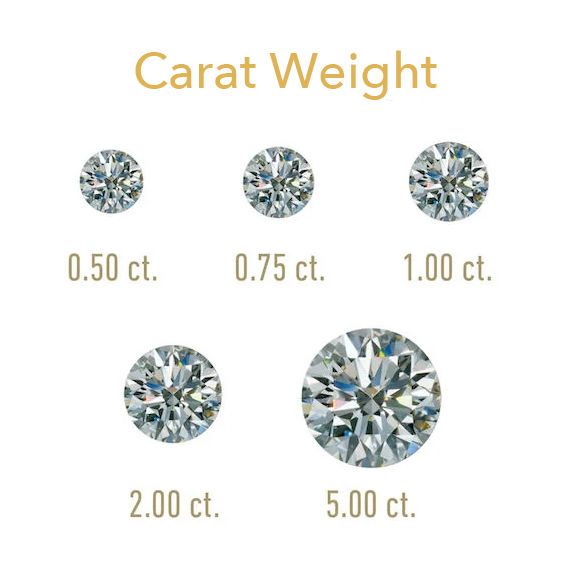
Diamond carat weight measures a diamond's mass, with 1 carat equaling 200 milligrams (0.2 grams). It is the most objective of the 4Cs, directly influencing price. Larger, rarer diamonds cost more. Weight is measured to the thousandth (0.001) of a carat and rounded to the nearest hundredth (0.01).
Diamonds are weighed using precise electronic scales. GIA rounds up to the next hundredth only if the thousandth digit is a 9.
A carat is divided into 100 "points" (e.g., 50 points = 0.50 carats), allowing for precise measurements.
Grading Categories:
-
Melee: Less than 0.18 carats.
-
Small: 0.18 to 0.99 carats.
-
Medium: 1.00 to 1.99 carats.
-
Large: 2.00 to 2.99 carats.
-
Very Large: 3.00 to 3.99 carats.
-
Rare: 5.00 to 10.00 carats.
Prices jump significantly at common weight milestones (e.g., 1.00, 1.50, 2.00) because these weights are rarer.
Two diamonds of the same weight can appear different in size (spread) depending on the quality of the cut. A poorly cut diamond may hide weight in the bottom (depth), appearing smaller when viewed from the top, whereas a well-cut diamond maximizes spread.
While larger stones are more expensive, weight alone does not dictate quality. A smaller, well-cut diamond can be more valuable than a larger, poorly cut one.

Ethical Diamond Sourcing
Diamonds have a violent and bloody history. Over the years, they have been mined by men, women, and children who are often underpaid or forced into labor. This is where the common phrase 'blood diamonds' comes from.
We obtain our mined diamonds through practices that prioritize human rights, fair labor, environmental responsibility, and supply chain transparency.
These diamonds are sourced from conflict-free zones, often with mine-to-market traceability, ensuring safe working conditions, fair wages, and minimal environmental impact.
The highest standard in ethical sourcing is tracking a diamond from the specific mine to the retailer, allowing companies to verify that ethical standards were met at every stage.
Programs like the GIA Diamond Origin Program or reputable suppliers like those in Canada provide this transparency.
Another way that blood diamonds are kept from entering the market is the Kimberley Process, which was established in 2003. The Kimberley Process monitors 99.8% of the global diamond trade to make sure that Diamonds entering the market do so by ethical means.
For these reasons, you can be assured that when you purchase a mined diamond from Richard Gretz that it will be an ethically sourced and conflict-free diamond.
Lab Diamonds
Why choose Lab Diamonds?
Lab-grown diamonds, also known as synthetic or cultured diamonds, are diamonds that have been grown in a laboratory rather than being mined from the Earth. Despite being created differently, lab diamonds have the same chemical composition, physical properties, and crystal structure as natural diamonds and so are real diamonds in every way. Because of this, people often ask whether lab-grown diamonds are better than natural diamonds, and truthfully, the answer depends on the factors you consider to be important.
To begin, we have to understand three things about lab-grown diamonds:
Identical Quality
They are chemically, physically, and visually identical to natural diamonds, a difference that cannot be detected by the naked eye.
Cost Affective
These diamonds ar a more affordable option while maintaining all the properties of a natural diamond.
Ethical and Sustainable
Since they are made in a lab, there is never any question of their origin as well as avoiding the environmental impact of mining
Greater purity and improved quality
One of the main benefits of lab-grown diamonds is that their production process allows for a greater degree of control over their characteristics, such as their size, color, and clarity. Since natural diamonds are mined from the Earth’s mantle, their quality and size are unpredictable, and it is easier for dirt and imperfections to be rooted within them. Cultured diamonds also have less strain applied to their crystal structure, so they are more likely to have fewer flaws. This means lab-grown diamonds can be produced with a higher clarity grade than natural diamonds, making them whiter, brighter, and generally better in quality. This is one of the reasons lab-created diamonds have become a more reliable choice for diamond jewelry buyers who are looking for specific characteristics.
Affordability
Lab-grown diamonds offer a compelling advantage when it comes to affordability without compromising on quality. Chemically and visually identical to natural diamonds, they are typically 30 to 40% less expensive, making them an attractive option for those looking to maximize value. This price difference comes from the production process. Natural diamonds require extensive mining operations, often involving significant labor, heavy machinery, and global transportation, which makes them both time-consuming and costly to bring to market.
Environmental Factors and Sustainability
Lab-grown diamonds are often considered a more environmentally conscious choice compared to their natural counterparts. Traditional diamond mining requires significant use of fossil fuels and heavy machinery, and it can dramatically alter landscapes by creating large open pits in the earth. It is estimated that mining natural diamonds generates around 160 kilograms of greenhouse gas emissions for every polished carat. While lab-grown diamonds do require energy to produce, many modern facilities are increasingly powered by renewable sources such as solar and wind energy, helping to reduce their overall environmental impact.
Lab-grown diamonds are also considered conflict-free by default. They are created in controlled laboratory environments without the need for mining or the use of forced labour, and their production process typically involves a more transparent and traceable supply chain. This distinction has made lab-grown diamonds an appealing choice for consumers who prioritize ethical sourcing alongside beauty and quality.